Studying mental health through AI and digital behavior analytics
Explore More
The growing prevalence of mental health disorders—such as depression, anxiety, and stress—calls for innovative, real-time approaches to detection and intervention. Traditional assessment methods, often dependent on sporadic self-reports and clinical interviews, are inherently limited by subjectivity and infrequent data sampling. In response to these constraints, this research proposes a comprehensive digital phenotyping framework that utilizes multimodal data sources including smartphone sensor data, web activity, voice signals, and facial expressions. By continuously monitoring these data streams, the system captures subtle affective cues and transitions that are often missed by conventional diagnostic tools. The integration of paralinguistic vocal features and micro-expressions augments the fidelity of emotional state detection, enabling higher granularity in mood analysis.
Our proposed solution combines a mobile application and web browser extension to collect, analyze, and interpret diverse behavioral and physiological signals using advanced machine learning models. The system is designed not only to detect emotional states and transitions with high predictive accuracy but also to deliver personalized, just-in-time interventions tailored to the user's emotional state. Furthermore, the architecture ensures data privacy through secure, privacy-preserving protocols. This integrated, scalable framework aims to bridge the gap between traditional mental health diagnostics and real-world, continuous emotional monitoring—offering a proactive and personalized approach to mental well-being.
A concise summary of existing technologies and methodologies used in mental health assessment through digital and physiological data.
Recent advances in smartphones, wearables, AI, and privacy-preserving tech have transformed mental health monitoring. Behavioral, physiological, and digital patterns are now analyzed using machine learning to assess mental well-being more accurately.
| Method | Data Source / Signal | ML/AI Used | Outcome |
|---|---|---|---|
| Text Analysis | Chatbot inputs, web searches | NLP, LLMs | Predict anxiety, depression via language cues |
| Screen Time Monitoring | App usage stats | Supervised ML, behavioral inference | Correlates with mood, sleep, content type |
| Voice Analysis | Speech recordings | RNNs, acoustic feature extraction | Detect tone, pace, and mood shifts |
| Facial Emotion Recognition | Video/Camera input | CNNs, Deep Learning | Classify emotions in real time |
| Music Therapy | User listening history / emotion data | Recommendation systems, mood analysis | Helps reduce anxiety & improve mood |
| Heart Rate Variability (HRV) | Wearable sensors | Signal processing, ML classifiers | Indicator of stress, anxiety regulation |
Privacy-preserving techniques like differential privacy and encryption are vital for securing sensitive user data. The integration of multiple data streams into unified predictive models using ML allows for accurate, real-time mental state monitoring. Future research should enhance these systems by focusing on standardization, ethical compliance, and efficient multimodal data fusion.
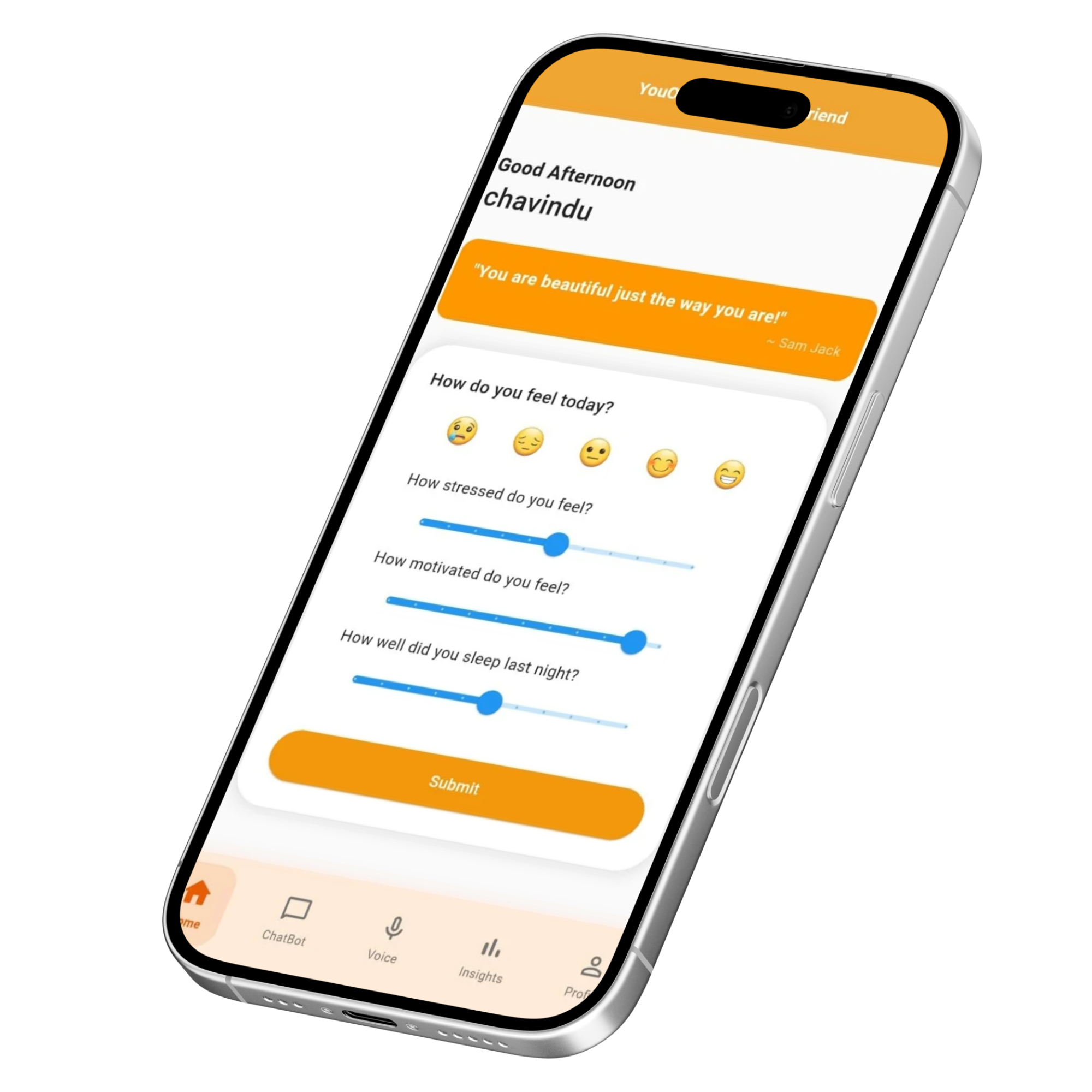
To address the limitations of traditional mental health assessment methods, our research introduces YouOkay—an AI-powered mental health monitoring system designed to deliver real-time, personalized emotional insights and support. This integrated solution consists of a mobile application and a browser extension that continuously collects and analyzes multimodal data, including screen time, app usage, web browsing patterns, voice signals, facial expressions, and text inputs. By leveraging the capabilities of machine learning, YouOkay detects subtle emotional transitions and prevailing affective states with high accuracy and granularity.
Our system is built around the concept of digital phenotyping, where behavioral data from smartphones and web interactions are analyzed to detect mental health changes. We enrich this process with additional modalities such as voice recognition and facial emotion detection, significantly enhancing the system’s emotional intelligence. YouOkay not only observes digital behavior but also actively engages users through a chatbot powered by Azure OpenAI, which offers contextual, just-in-time support tailored to the user's predicted emotional state. Privacy and data security are foundational to our design, incorporating encrypted protocols and user consent at every step.
Mobile app and browser extension for continuous, real-time data collection and feedback.
Advanced ML models analyze screen time, voice, face, and browsing behavior for emotional prediction.
Context-aware chatbot offers just-in-time support and suggestions based on your current mental state.
Track and visualize emotional trends over time with detailed analytics and personalized summaries.
Extensible framework that allows integration with new data sources and personalization layers.
Faculty of Computing
Sri Lanka Institute of Information Technology, Malabe
Faculty of Computing
Sri Lanka Institute of Information Technology, Malabe
Faculty of Computing
Sri Lanka Institute of Information Technology, Malabe
Faculty of Computing
Sri Lanka Institute of Information Technology, Malabe
Faculty of Computing
Sri Lanka Institute of Information Technology, Malabe
Faculty of Computing
Sri Lanka Institute of Information Technology, Malabe
For more information, visit our website:
YouOkay Website